
Star of the Month: Betty Hutton
- Gurveer Boyal

- Nov 5, 2020
- 5 min read
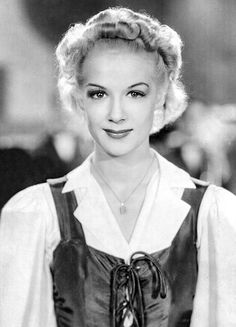
One day, she was Paramount's top musical comedy star, the next, she was no where to be seen. I'm talking about Betty Hutton, the blonde bombshell who dominated screens from the 1940s to the 1950s. While she isn't very remembered now, she made a number of classics, such as 'The Miracle of Morgan's Creek' (1944), 'Annie Get Your Gun' (1950) and 'The Greatest Show on Earth' (1952).
Betty Hutton was born on 26th February 1921, under the name of Elizabeth June Thornburg. She had an older sister, Marion Hutton, who would have her heyday before Betty. Betty's father left the family while Betty was only a child, and she didn't hear of him again until his deah by suicide. Due to her mother's alcoholic behaviour, Betty and Marion often had to look after her. Betty would also perform in the family speakeasy from as early as three years old.
Since she was a great singer, she made a few musical shorts for Warner Bros. in the late 1930s, the most notable one being 'Public Jitterbug No. 1' (1939), hence the nickname "America's Number 1 Jitterbug".
Hutton's musical talent also landed her a role in the 1940 Broadway musical 'Two for the Show'. She also appeared in 'Panama Hattie'. Broadway legend Ethel Merman played the main role. According to rumours, Ethel cut out Betty's big musical numbers because she didn't want Betty to upstage her. Buddy DeSylva, the producer of the show, promised to make Betty a film star.
Buddy DeSylva became a producer for Paramount Studios, and he instantly signed Betty Hutton to appear in 'The Fleet's In' (1942). Betty was signed to appear in a number of other films, and while she may not have been given star billing, she was very popular with movie audiences. A frequent co-star of her's was Eddie Bracken. In an interview, Eddie revealed that he didn't want to work with Betty because he was just being used to promote Betty to stardom. However, the two were friendly towards one another.
Betty's first major triumph was the screwball comedy, 'The Miracle of Morgan's Creek' (1944). The film, directed by Preston Sturges, also featured Eddie Bracken. Bracken was hesitant to make this film because he didn't want to be in a film where he just boosted Betty's musical talents. Luckily for him, this wasn't a musical film, and Betty would only lip-sync to one male voice. The film is about a woman who gets married and pregnant while drunk, but can't remember the name of the man when she is back to normal. The topic was considered too serious by the Hays Code office, and wasn't released until two years after it was completed. As expected, the Hays Code office received many letters protesting the film's serious subject matter, though it became Paramount's highest-grossing film of 1944.
Eager to give Betty more acting credits, Paramount kept Betty busy with a series of films alongside stars such as Freddy MacMurray and Bing Crosby. She also became Paramount's top female star. Her fame allowed her to be one of the first stars to sign up to Capitol Records.
When Buddy DeSylvia left Paramount, Betty's relationship with the studio began to crumble. Her next few films didn't really interest her.
One of Betty's most famous movies is 'Annie Get Your Gun' (1950). Betty had begged Paramount to buy the film rights to the highly successful musical, but Metro-Goldwyn-Mayer (MGM) ended up buying the rights instead. At the time, Judy Garland was MGM's top musical star, and she was cast in the role of Annie Oakley. However, with a dissolving marriage, clashes with the director, and general exhaustion, Garland was so unfit for work that she wasn't fired from only the film, but also from the studio. Now, without a lead actress, 'Annie Get Your Gun' was paused from production. Upon hearing of Garland's firing, Betty was quick to lobby for the role of Annie Oakley. When she was hired, the character was rewritten to match Betty's energetic personality.
Filming 'Annie Get Your Gun' wasn't easy in the slightest bit. Howard Keel, Betty's co-star, thought Betty cared more about her career than her co-stars. He also claimed that on one occasion, Betty made everyone re-film a scene over 50 times because she wasn't pleased with it. On the other hand, Betty claimed that no one treated her with any kindness because she had replaced Judy Garland. She also said that Judy once visited the set and began screaming a string of profanities towards her. However, the two would later reconcile when performing at a club in Las Vegas.
Despite the troublesome production, the shooting for 'Annie Get Your Gun' was completed ahead of schedule. When it was released, it was MGM's biggest biggest musical of 1950. A lot of critical praise went to Betty. However, 'Annie Get Your Gun' overshadowed Betty's other 1950 film, 'Let's Dance', with Fred Astaire. Fred and Betty's performing styles clashed, as Betty was too energetic for Fred's simple taste. However, the two enjoyed working together.
Betty Hutton played Holly in 'The Greatest Show on Earth', along with Charlton Heston, Cornel Wilde, James Stewart and Gloria Grahame. Cecil B. DeMille, the director, was very demanding of his actors, and expected them to perform their own stunts. Betty hadn't been the first choice for the role of Holly, and she was only allowed to take the role if she slimmed down her hips. In the end, she agreed and made a very good Holly.
Betty's relationship with Paramount completely feel apart when her husband couldn't direct all her films. This caused her to walk out of her contract. Since the 1950s saw a rise in the ownership of televisions, Betty was able to transition to TV shows. She even had her own show - 'The Betty Hutton Show'.
In 1967, Betty Hutton was given another chance to work for Paramount in two low-budget western films. However, she was fired quite quickly since she couldn't keep up with the fast working schedule. She never did make another film.
By this point, Betty had practically disappeared from the public eye. While she did a few Broadway shows and an occasional television appearance one in a while, she was no longer a major star. In 1986, Betty got a psychology degree at Salve Regina University. She dropped out of school in the 9th grade, so received her education as an adult. Her best friend at university was Kristin Hersh, who was younger than an average university student. Despite living near each other in Betty's final years, the two never met after their university days.
The one thing Betty didn't have in her life was the support of her children. She even went as far as to say that her children brought her no happiness. Since Betty was a victim of drug abuse, she ended up being estranged from her daughters. She did reunite with two of her daughters, and ended up living with her. However, Betty quickly became distant from them again. None of them attended Betty's funeral. She was also quite distant from her sister, Marion, and the two only interacted if their careers brought them together.
The only real hope in Betty's life was Catholicism. After having a nervous breakdown, an attempted suicide, a failed marriage and bankruptcy, Betty turned to religion and began getting her life together again.
Betty's final years where very isolated. She had lost most of her close friends and family, and her caretaker was the only person who she was really close with.
On 12th March 2007, Betty passed away due to colon cancer complications, aged 86.
Sadly, many of Betty's films haven't had an official HD DVD release, but they are still available online and should be watched!




Comments